The Use of Neurological Segmentation in Equine Osteopathy

7 Apr 2025 Equine

Click to view


Touch a vertebra, and you are not just touching a bone. You are entering a neurological network that extends outward to skin, organs, muscles, and the brain itself. This is the central insight of Frouke-tea Friedhoff’s thesis, which argues that equine osteopaths who understand neurological segmentation can address the underlying cause of dysfunction rather than managing only its visible symptoms.


The paper moves methodically through the architecture of the equine nervous system — central and peripheral, motor and sensory, somatic and autonomic — before arriving at the heart of its subject: the ways in which spinal segments, somatotopic maps, referred pain patterns, and dermatome regions can each guide more precise osteopathic diagnosis and treatment.


Particularly compelling is the discussion of spinal segmentation in practice. Working on the thoracic region at Th1–Th3, for example, carries implications not only for the vertebrae themselves but for the lungs, the heart, and the brachial plexus. The practitioner who knows these connections treats with intention rather than by location alone.


The thesis also explores somatotopic mapping — the idea that each region of the body corresponds to a specific point in the nervous system and in the cortex. Drawing on both human research and emerging equine-specific auricular acupuncture maps, Friedhoff suggests these tools could significantly enhance osteopathic diagnosis, helping distinguish whether a spinal lesion originates from the vertebral column or from organ dysfunction.


Referred pain in the horse is examined with appropriate caution — it is difficult to detect and often overlooked — but the author makes a persuasive case that ignoring it risks misattributing lameness to the wrong source. A dull coat, an unusual hair pattern, a subtle asymmetry: Friedhoff shows us how to read these as neurological signals. The thesis ultimately invites practitioners to look past the surface and ask: what is the body actually telling us?

Honoring Our Noble Companions

31 Mar 2025 Equine

Honoring Our Noble Companions: Celebrating the National Day of the Horse

Every December 13th, we honor one of humanity’s most loyal and noble companions with the National Day of the Horse. This day serves as a tribute to the profound influence horses have had on our lives, shaping history, culture, and even the economy. Whether they are galloping freely in the wild, standing proudly in a parade, or offering quiet companionship, horses remain symbols of strength, beauty, and resilience.

The Legacy of the Horse

For thousands of years, horses have played an integral role in human civilization. In the United States, their contributions are deeply intertwined with the country’s story. From aiding humans in mobility and hunting to powering the expansion westward, horses have been steadfast partners in exploration and survival. They’ve tilled fields, carried soldiers into battle, and transported goods across vast terrains. Their legacy is one of tireless service and unwavering loyalty.

More Than Just Work

Horses aren’t only remembered for their labor. They are companions, athletes, and healers. Equestrian sports like show jumping and dressage highlight their incredible athleticism and intelligence, while therapeutic riding programs provide solace and recovery for individuals with physical and emotional challenges. Wild horses, such as the mustangs of the American West, or the Alberta Wildies of Canada, embody a spirit of freedom and untamed beauty that continues to inspire us.

Why This Day Matters

The National Day of the Horse is a moment to reflect on how deeply connected we are to these magnificent creatures. It also raises awareness about the challenges they face today, from habitat loss to issues of neglect and overbreeding. Advocacy and education are key to ensuring that horses continue to thrive in both domestic and wild settings.

Ways to Celebrate

If you’re looking to honor horses today, here are a few meaningful ways to celebrate:

  • Visit a Stable or Sanctuary: Spend time with horses to appreciate their gentle nature and strength. Many local stables or rescues offer tours and volunteer opportunities.
  • Learn About Their History: Explore the rich history of horses in your region or dive into books and documentaries that showcase their impact on society.
  • Advocate and Donate: Support organizations dedicated to protecting wild horses, promoting equine welfare, and offering therapy programs.
  • Share Your Story: Use social media to share your experiences with horses. Whether it’s a childhood memory or a recent trail ride, personal stories highlight the special bond we share with them.

A Lasting Bond

Horses are more than animals; they are a testament to the enduring partnership between humans and nature. As we celebrate the National Day of the Horse, let us honor their legacy and ensure that future generations have the opportunity to marvel at their grace and power. Take a moment today to appreciate these incredible creatures and the immeasurable joy they bring to our lives.

For more information on how you can become an Equine Osteopath, click here 

‍

The effect of the rider on horses asymmetries in consideration of equine osteopathic diagnosis.

26 Sep 2024 Equine

Click to view


Every horse carries a degree of natural asymmetry — a preference for one side, a dominant limb, a slight spinal curvature — and experienced equestrians tend to know this. What receives far less attention is the asymmetry the rider brings to the equation. Horses have been carrying humans for over five thousand years, but it is only recently that the rider has begun to be studied as a biomechanical variable in their own right.


This systematic literature review examines ten studies on horse-rider interaction, looking specifically at how rider asymmetry affects the ridden horse’s movement patterns — and what the implications of those findings might be for equine osteopathic diagnosis. The results are striking. In eight of the ten studies, the rider was found to have a measurable negative effect on the horse’s symmetry, with the most pronounced effects appearing during rising trot.


The author contextualises these findings through the lens of osteopathic theory, applying the biomechanical, respiratory-circulatory, neurological, metabolic and behavioural models to explain the mechanisms through which rider imbalance translates into tissue change in the horse. A collapsed hip in the rider, for instance, increases loading on the horse’s contralateral side. A rider with a shortened stirrup creates measurable changes in thoracolumbar range of motion in the horse. Even the diagonal a rider sits on in rising trot can mimic hindlimb push-off lameness.


Crucially, the thesis also addresses the limits of what riders themselves perceive. Several studies found that rider assessment of a horse’s ‘hollow side’ did not reliably match objective kinematic data — a finding with direct implications for any osteopath who relies on rider reports as part of their case history.


The thesis calls for a more integrated approach: one where the horse and rider are assessed together, and where the equine osteopath considers the person in the saddle as part of the clinical picture. It is a perspective that reframes how we think about asymmetry in the ridden horse — and raises questions that the field is only beginning to answer.

The role of osteopathic manual treatment in performance horses

3 Jun 2024 Equine

Click to view


Pain shapes equine performance more profoundly than almost any other variable. It need not produce overt lameness to have an effect — subtle discomfort alters movement patterns, stiffens the thoracolumbar spine, and triggers compensatory strategies that eventually become problems in their own right. Felicity Warren’s thesis takes this premise seriously and builds a methodical case for osteopathy as a central pillar of performance horse management.


The thesis examines three interconnected areas: back pain and its effect on gait, lameness and its whole-body consequences, and the physiology of soft tissue injury in equine athletes. Each is reviewed through an osteopathic lens, drawing on randomised controlled trials, systematic reviews, and biomechanical studies to support the argument that manual therapy offers measurable benefits — not merely anecdotal ones.


One of the more striking pieces of evidence cited involves a controlled trial on thirty-two Thoroughbred racehorses, in which cranial osteopathic therapy raised mechanical nociceptive thresholds — in effect, making it harder for pain pathways to fire — in the majority of treated animals. Another study found that horses with musculoskeletal issues showed stride lengths 17% shorter than controls; following osteopathic treatment, those same horses surpassed the control group. These are not marginal results.


Warren is equally attentive to the factors that complicate care: saddle fit, rider influence, training surfaces, and the horse’s instinct to mask pain. She notes that a lame horse stiffening its thoracolumbar region may simultaneously develop epaxial muscle atrophy — and that what looks like a limb problem may originate in the cervical spine. The osteopathic principle of treating the whole body, not the presenting complaint, is what makes this approach coherent rather than compartmentalised.


The thesis is honest about the evidence base. Quality clinical trials in equine osteopathy remain limited, and Warren does not overstate their conclusions. But the anecdotal weight, combined with the physiological rationale for soft tissue mobilisation, joint articulation, and lymphatic drainage enhancement, adds up to a compelling argument — one that she argues the equine industry is already voting on with its feet.

Easing a Difficult Calf Birth with Craniosacral Osteopathy

5 Mar 2024 Equine

Easing a Difficult Calf Birth with Craniosacral Osteopathy

‍

As an experienced animal osteopath, course creator and member of the teaching faculty at London College of Animal Osteopathy (LCAO), Prof. Vickie Keam has treated canines, equines and cows of all ages. Here, a client describes how Prof. Keam was instrumental in easing a difficult calf birth through  craniosacral osteopathy.

‍

Pippa, the ranch pet cow had a very restless labour as she kept getting up and repositioning. After the long birth, we gave Pippa and her new calf space to bond. Returning a few hours later, I found a still agitated momma that was constantly mooing at her calf. The calf was laying flat on its side and kicking its back leg. It would get up, walk a few feet away and proceed to try and lay down, which was more of a flop. I watched the calf for about half an hour thinking it had gotten stepped on. I decided to send a video to our long-time Equine Osteopath, Vickie Keam, to ask if there was something that could be done. Vickie lives 3 hours away so she talked me through craniosacral and how to put my hands around the calf’s ears with my thumbs on her forehead and not to squeeze but to just feel and think positive.

While following Vickie’s instructions, I just kept telling myself to think the head needs to go normal. I could feel the slightest shift as her head readjusted. The newborn was standing during this time with her head almost to the floor, after ten minutes she did a big stretch and then another about a minute later, she then walked away from me and laid down like a normal calf, curled up and fell asleep. Pippa walked over to her baby, sniffed her, licked her, and laid down beside her calf and proceeded to chew her cud. Happy momma and calf.

‍L. Clark, Alberta Rancher

The first 12 hours of the calf’s life.


This is an hour after Prof. Keam talked the owner through craniosacral.
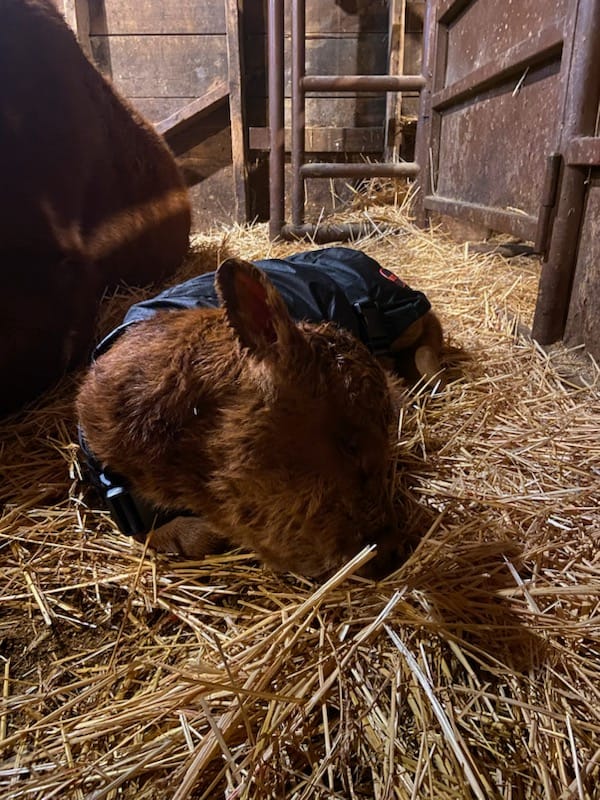


This is 24 hours after receiving craniosacral osteo.


For more information on how you can become an animal osteopath, click here

‍

1 2 3 4

Search

+